Tech · Equipment
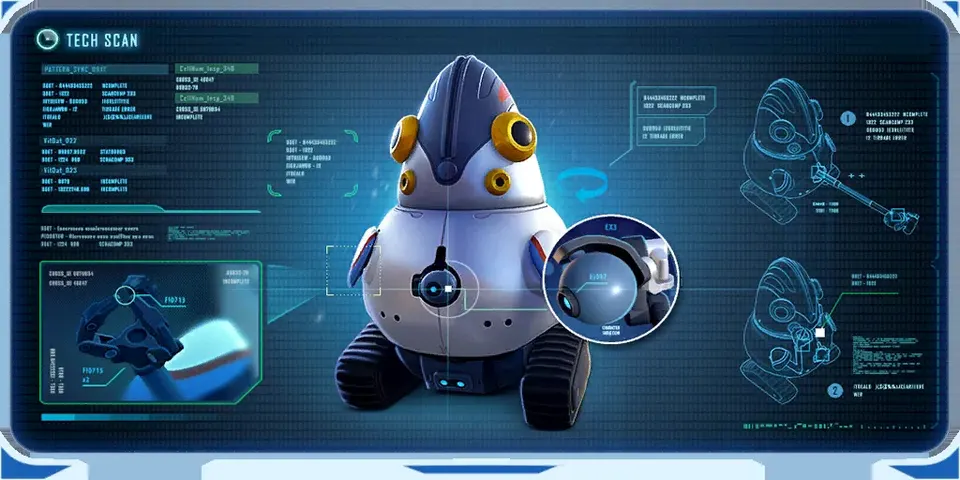
Spy Pengling
The spy pengling provides new avenues for researchers to access natural above-ground habitats. It is especially effective at maneuvering through spaces otherwise too small for humans.
Pengwings are highly active creatures, who are protective of their young penglings. In order to better study these energetic denizens of the arctic region, Alterra scientists on 4546B had to think outside of the base.
A well-known phenomenon, the Vee Caecus principle, asserts that in order to best study fauna, one must become the fauna. Scientists across the stars have used this basic principle to infiltrate and observe alien creatures of all sizes and dispositions. Drs. Caecus, Curtis, Tuson, and McBeth pioneered these accomplishments.
Inspired by this, and after months of trial-and-error, the first spy pengling was crafted at Phi Robotics Center, bringing about a new era of exploration and excavation across all operating outposts.
(Warning: Research to create a waterproof edition of the spy pengling was halted due to compliance concerns. Currently, contact with water will result in complete system failure.)
Features include:
Fully customizable outer shell to replicate any small, bipedal creature Two all-terrain tracks for smooth movement over rough conditions Remote controller for operating at distances up to 80 meters away (atmosphere dependent) Four storage slots Self-destruct option in case of danger or immobility Arm with three-pronged claw for picking up samples Fully detachable camera with 180 degree rotation to observe spy pengling and surrounds
‘The Spy Pengling: Sit back, relax, and let the robot do the hard work.’